PRO LOCO TRABIA – SAN NICOLA APS
Corso G. La Masa n.165 – 90019 Trabia (PA) C.F. 87003570824
Tel. 0918104090 prolocotrabiasannicola@gmail.com prolocotrabia@pec.it
Powered By GIO DIGITAL MARKETING
Trabia itinerary
PALERMO GATE
Point of interest no. 1
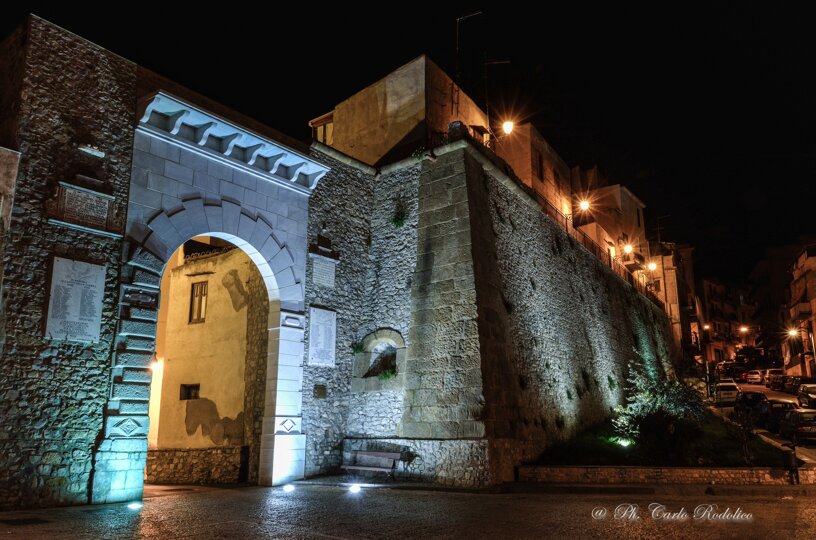
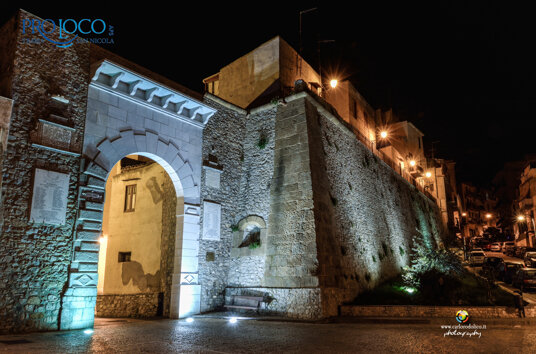
Walking along state road 113, toward Messina and taking the junction for the town center of Trabia, after passing under the railway underpass, one finds oneself before the ancient city walls. Due to their partial demolition during the Second World War, they were restored in 2008. The walls were built by Prince Ottavio Lanza II, known as the Builder, in the first half of the 17th century, to defend the small village and the lands around the castle. On the side walls of the gate there are four plaques, two of which date back to the same period as the construction of the walls: in the first the prince claims rights over these lands, in the second he invites passersby, with great hospitality, to pleasantly enter the territory with the following words: “Without fear enter this land, friendly guest, a dwelling and safe hospitality invite you here, far from here flee snares, frauds and deceptions, sacred faith, piety and religion dwell here, this land is guarded, a lion with watchful gaze protects you and the lineage from Bavaria under the guidance of the Lanza. It is cruel to the guilty and gentle with the innocent, to these it is favorable, while it drives the others away by biting them.”. The other two plaques instead bear the list of the fallen men of Trabia who sacrificed their lives for the defense of the Homeland during the First World War.
S. OLIVA
Point of interest no. 2
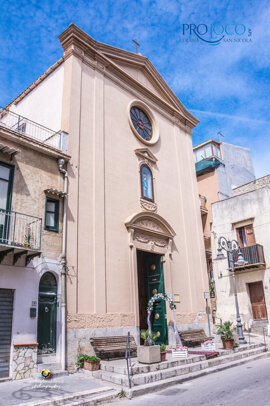
Passing through the gate of Trabia stands the splendid Church of Sant’Oliva, the oldest in the village, built in 1643 at the wish of Don Ottavio Lanza. The Church was used until 1800 as the local cemetery. It is marked by a simple single-nave structure, and has a precious altar from the church of Castello Lanza, and inside it are kept two splendid works. The first is the martyrdom of Saint Stephen, which would seem stylistically linked to the school of Pietro Novelli. The second is a Madonna with Child made according to Flemish styles or deriving from the Antonello tradition.
PIAZZA LANZA AND WASH HOUSE
Point of interest no. 3
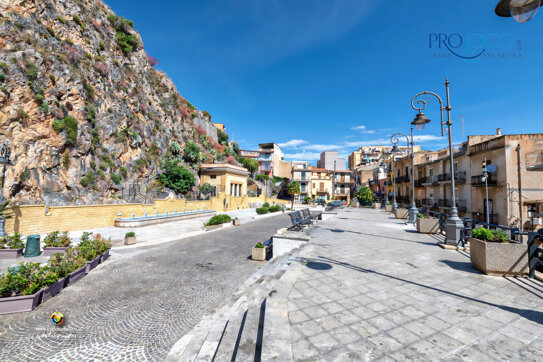
Proceeding toward the town center, you reach the Square dedicated to Giuseppe Lanza, a key meeting point for local youth and those from nearby towns. On the right side, it is marked by a limestone rock wall that, over the past millennia, has been affected by a vertical fault. Close to this fault, one can admire a nineteenth-century basin, adorned in the upper part with the marble coat of arms of the Lanza Family. It is fed by 10 taps called “cannoli”, which until the Sixties poured into it over 200 liters of water per second. To the right of the basin, one can notice the structure of an ancient aqueduct built during the Fascist era. Next to the aqueduct, there is still today another small basin with two “cannoli” from which drinking water flows. In the street below the Square, the remains of an ancient washhouse can be seen, which until the Fifties was used by the town’s housewives to wash laundry. Inside the Square, one can also notice a monument to the Unknown Soldier, dedicated to those fallen in war.
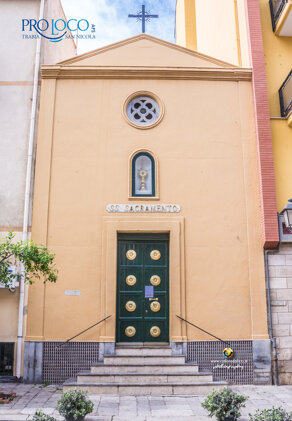
HOLY SACRAMENT
Point of interest no. 4
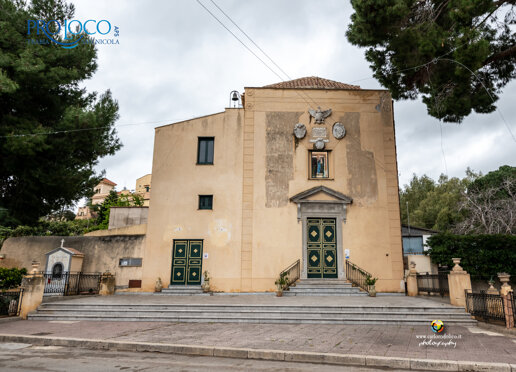
Proceeding toward the center along the main Corso, dedicated to Giuseppe La Masa, Garibaldian general and national hero, on the right side, it is possible to admire the Church of the Most Holy Sacrament. It was built in 1715 at the wish of Don Ignazio Lanza, Deputy of the Kingdom and Captain of Justice as well as Praetor of Palermo, following a demographic increase in the local population. The Church, initially dedicated to the Patron “Most Holy Crucifix,” was blessed by the Archpriest Don Giacomo Buccheri on January 11, 1716. The Church, according to the layout of the other churches of Trabia, presents itself with a simple façade aligning the portal, the shrine, and the rose window, a simplicity that is also reflected inside with the exception of the sumptuous tabernacle.
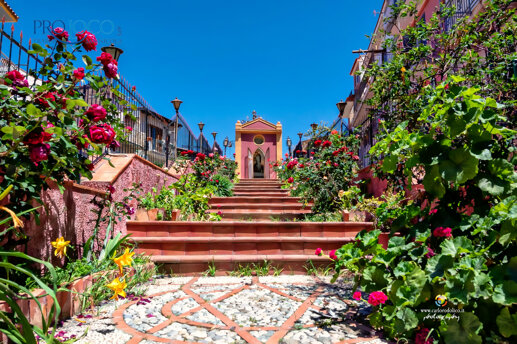
CALVARY CHAPEL
Point of interest no. 5
Proceeding toward the center, you reach Via Calvario, a road that leads to the oldest quarter of Trabia. On it stands a small Chapel (Calvary Chapel) built in April 1830 at the wish of the religious institution still present in the town today. The picturesque Chapel was built on top of a quartz sandstone rock, still visible today: when reduced to sand, it was used by the women of the neighborhood to carefully clean cookware blackened by the flames. Behind the rock stands a large iron cross with three lights at the ends symbolizing the Trinity. It is used by the faithful throughout the month of May for the recitation of the Holy Rosary, during the week of the Sacrament and for Holy Week on the occasion of the procession of the simulacrum of Jesus Christ and the Sorrowful Virgin. Near the Chapel are the Birthplace of the “Servant of God” Fra’ Andrea Tonda and two small squares, one marked by a large fig tree placed at its center, the other in front of the Chapel, from which it is possible to notice the sandstone rock.
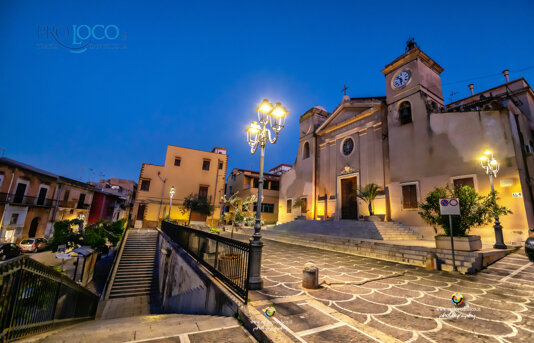
MOTHER CHURCH OF SAINT PETRONILLA
Point of interest no. 6
The Mother Church of Trabia, dedicated to Saint Petronilla, was commissioned by Giuseppe Lanza. Construction began in 1790 and was completed in 1802. The church was initially built with a single central nave. The two side naves, built following the demolition of the walls, date back to 1870. Trabia's Archpriest, Monsignor Antonino Di Matteo, had the high altar constructed in fine white marble in 1885, the five side chapels and the marble flooring of all three naves in 1887, and finally the façade in 1892. Inside the Mother Church, a bronze cross is kept, discovered in 1830 by a young man named Carlo Bondì while collecting sea pebbles to adorn the Calvary Chapel, which was still under construction. Its discovery is believed to have led to the definitive eradication of the plague that was plaguing the local area at that time. It is no coincidence that the inhabitants carried the cross in a solemn procession into the church where it remains today. The ends of the Latin cross widen into small trilobate heads that enclose sacred images: on the main face is the crucified Jesus surrounded by the four evangelists, while on the secondary face is the Madonna and Child. Professor Ettore Gabrici, Director of the Palermo Museum at the time of its discovery, described the cross as "a valuable product of Sicilian industry with distinct characteristics of fifteenth-century art." Inside the church is kept a painting depicting Saint Petronilla, after whom the church is dedicated; in addition, a valuable painting depicting the Virgin of the Rosary and a painting depicting Saint Peter attributed to the Spanish painter Jusepe De Ribera (Xàtiva, 1591, Naples 1652), known as Lo Spagnoletto. The remains of the Servant of God Fra' Andrea Tonda have been kept inside the church since 1973.
MADONNA DELLE GRAZIE
Point of interest no. 7
The Church of the Madonna delle Grazie was built between 1635 and 1945 as a boundary between the "City of Spas" (Termini Imerese) and the fiefdom of Trabia. Inside the church, you can admire a large papier-mâché crucifix and a work from the school of the famous painter Pietro Novelli, depicting the two celestial protectors of the city of Termini Imerese, Saint Calogero and Blessed Augustine. Furthermore, there is a very ancient painting on stone, by an unknown artist, depicting the image of the Virgin Mary with Saint Joseph and baby Jesus. It was found in an ancient "edicule" located on the stream in front of the church. Inside the church are some stuccoes from the Serpotti school dating back to the 17th century. A popular legend has it that the crucifix was stolen one night to be taken to nearby Termini Imerese, but punctually, the next day, it was found again in the central nave of the Church of the Madonna delle Grazie. Adding to the veil of mystery is the trace of clay on the feet of the Crucifix which seems to have wanted to return to the Trabia soil to which it belonged.