
PRO LOCO TRABIA – SAN NICOLA APS
Corso G. La Masa n.165 – 90019 Trabia (PA) C.F. 87003570824
Tel. 0918104090 prolocotrabiasannicola@gmail.com prolocotrabia@pec.it
Powered By GIO DIGITAL MARKETING
The Tonnara of Trabia
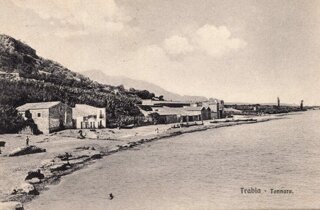
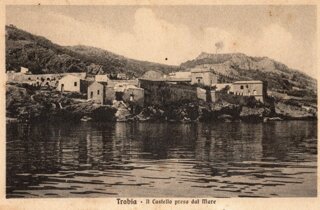
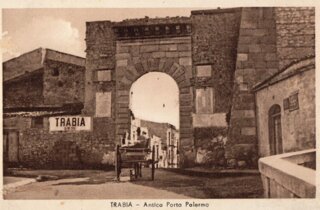
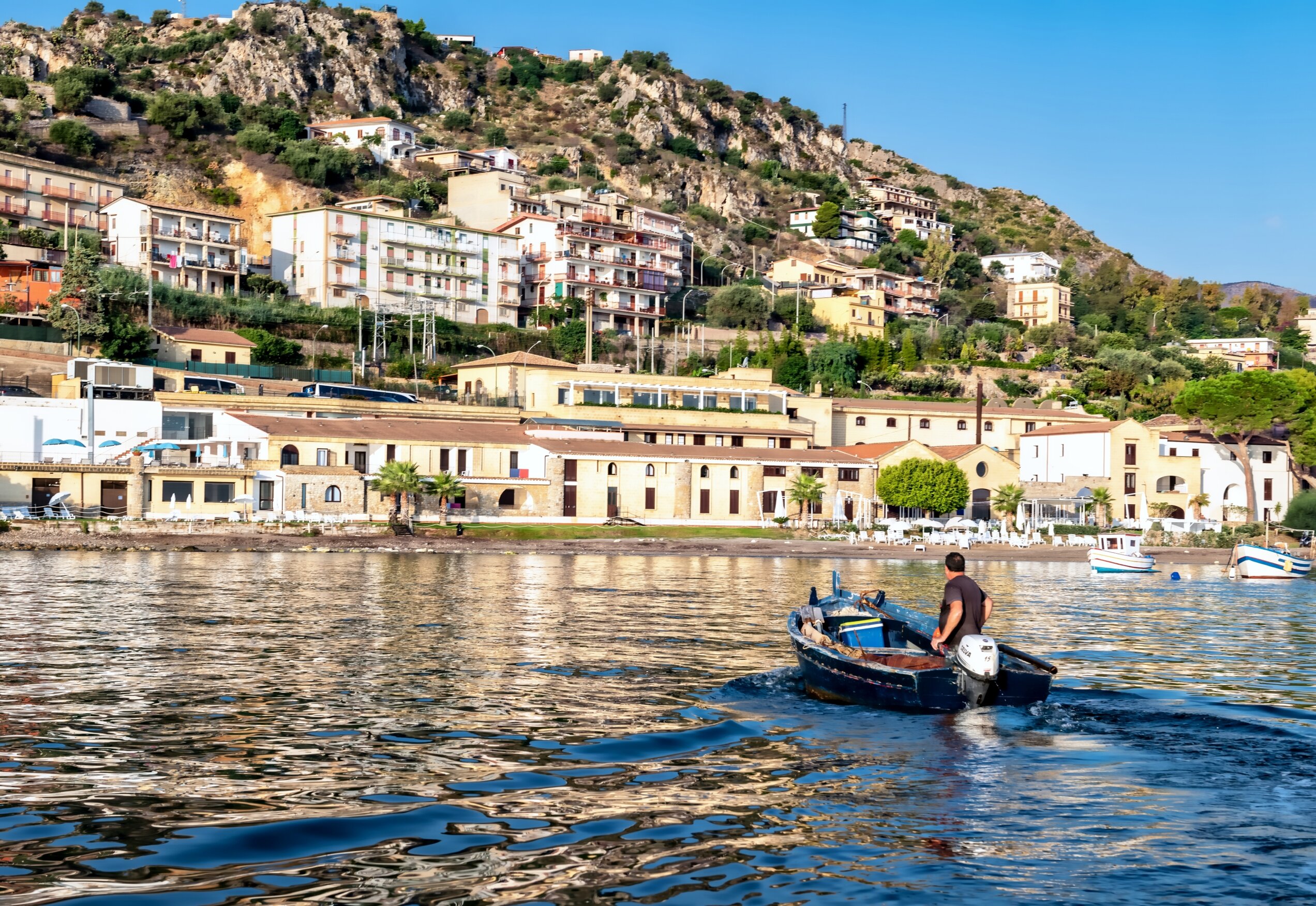
We find ourselves in the early postwar years in a small town in the province of Palermo, known for its ancient tuna fishery belonging to the Lanza dei Principi Di Trabia family. The Allied landings caused considerable damage, with bombings and passing tanks destroying the beautiful Palermo Gate. The walls and gate were built by Prince Ottavio Lanza II, known as the Builder, in the first half of the 17th century to defend the small village and the lands surrounding the castle.
But back to the tuna fishery: it was the month of April, and preparations for the tuna fishery began. It was a time of celebration for the entire town, but it was also a time when labor was needed, and the people of Trabia employed themselves as carpenters, fishermen, shipwrights, and so on…
We all imagine tuna fishing at sea, but preparation begins on land with the boats being repaired and restructured using "stuppatura" (tow used to fill cracks in the boats). Finally, they are "pisciati" (thin tar) used to fill cracks in the boats, giving the tuna fishing boats their classic black color.
The tuna fishing boats had various types of boats; in Trabia, there were five "muciare," a sciabichedda, a caiccu, and a basciddatura.
Once all the boats were repaired, the nets were patched and provided with ballast tied with Disa ropes. (At that time, for economic reasons, fishermen used rocks as ballast, and among these even the remains of the arch of the Palermo gate ended up). Everything was loaded onto the boats waiting for the right sea current, the so-called east row, which allowed the tuna fishery to lower itself into the water straight and precisely.
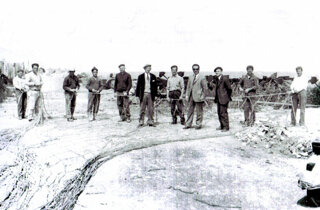
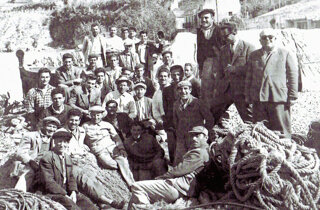
So starting from the beach, the 45 men who made up the Trabia tuna fishery began to descend until they reached a depth of about 50 meters, about 3 km from the shore where the rooms were located. As a reference point from the shore they had a funnel and from the mountains the apse of the whitewashed hermitage of San Felice.
The tuna fishery had three chambers: the Porta chiara, the u bastardu, and the leva, or chamber of death. Each chamber was manned day and night by a boat. As soon as the tuna entered through the first, the clear door, located further east than the others, it was barred and the tuna were forced to pass through the second, the u bastaiddu. Here, lines were lowered, and based on their quantity and movement, they were able to quantify the number of tuna inside. For example, four lines meant there were between 100 and 150 tuna. Unfortunately, it wasn't that simple. In many cases, after they had established that the chamber was full enough to carry out the slaughter, the next day everyone was ready and found nothing because the u mmistinu, a shark, had arrived during the night, tangling the nets and scaring away the tuna, which managed to escape. Therefore, the fishermen had to intervene to restore everything.
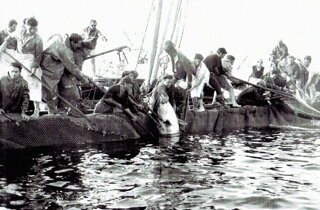
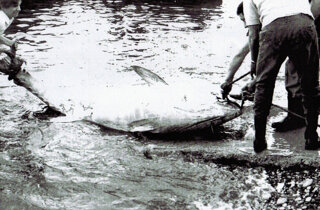
The day arrives. All 45 men, led by the Rais, the Sub-Rais, and the foreman, are ready on the muciare around the draft chamber. They begin to haul in the nets and bring up, or rather, toss in, the tuna. At that point, the sea begins to turn red. The tuna-batting begins. The women on shore begin to pray for a plentiful catch and for the health of the sailors. The draft becomes a death chamber. The tuna begin to struggle and sometimes even leap onto the muciare on their own.
At this point, the sciabichedda comes into play, its task being to bring all the tuna ashore. Once they reach the shore, they are loaded onto carts that are then taken to a nearby location to be weighed and sold at auction; in fact, the location was called a vinnita.
The history of the Trabia tuna fishery, one of the longest-running, having been active since 1375, came to an end in the mid-1960s, after nearly 600 years of hard work, sacrifice, and tradition.
Linked to it we remember the tradition ru tunnu ro Signuri, the largest tuna was transported with a cart, a garland of oleanders was placed on its head and sold, all the proceeds were donated to make the patronal feast, the feast of the Crucifix or a festa ru Signuri, we also remember the feast of Corpus Christi which reached the tuna fishery in the small church annexed to the warehouses to bless the tuna fishery and the tuna fishermen, the oleander crown that was thrown into the water at the point where the tuna fishery began to be lowered, and also from the tuna fishery comes the tradition of processions, all the brotherhoods come out of the walls of the town with the Vare (fercolo) to reach the end of a climb that is called a crucidda to greet and bless the tuna fishery that has given so much to the development of Trabia.