PRO LOCO TRABIA – SAN NICOLA APS
Corso G. La Masa n.165 – 90019 Trabia (PA) C.F. 87003570824
Tel. 0918104090 prolocotrabiasannicola@gmail.com prolocotrabia@pec.it
Powered By GIO DIGITAL MARKETING
Trabia and the origins of dried pasta
In October 2002, an official delegation from the Municipality of Trabia participated in the "Pasta Show" held in Naples. On that occasion, the municipal administration had printed a small brochure, which, on the cover, bore this headline:
Trabia…the birthplace of spaghetti.
In reality, the first to claim this "paternity" was Piero Zizzo, a respected scholar of local traditions. In a publication of his dedicated to the history of Trabia, published in 1982, he highlighted the now-famous passage by Arab geographer Al Idrisi regarding the production of "Itriya" pasta in Trabia. Since then, all major websites dealing with the history of pasta, and even in reputable scientific publications on food and gastronomy, have consistently cited Trabia as the place, or at least one of the oldest places, where the direct ancestors of our modern-day "Spaghetti" were produced.
As has long been understood, behind every gastronomic product, behind every dish, behind every flavor, one perceives, as someone has written, a "strong historical aftertaste." Therefore, it is always worth remembering that it is worth studying these stories, preserving and promoting these products, these dishes, these flavors, as so many "cultural assets."
The most authoritative food historians who have investigated the origins of pasta agree that the Arabs, through the two privileged channels of Spain and Sicily, introduced this new product to Europe. The first evidence of this dates back to the 11th and 12th centuries, if not earlier, and it is precisely in Sicily, with its Arab tradition, that we find the first dried pasta factories destined for export. In the "Book of Roger," a geographical work by the Arab author Al Idrisi, composed in 1153, we can read this interesting description:
To the west of Termini lies the town of Trabia, an enchanting site, rich in perennial waters and mills, with a beautiful plain and vast farms where “itrìya” (vermicelli, spaghetti) are produced in quantities sufficient to supply not only the towns of Calabria, but also those of Muslim and Christian territories, where large shipments are sent.
It is certain, therefore, that in the territory destined to host the future feudal foundation of the Lanza family, the pasta industry thrived, particularly the type specifically mentioned by Al Idrisi: the <itrìya>. Using durum wheat semolina (Triticum durum), as is well known, the Muslims who settled in Spain in the Middle Ages also made, in addition to the traditional couscous, certain types of dried pasta such as <fidaus> and <itrìya>. To prepare the latter, known in the Islamic East as <rishta>, the dough was rolled out into sheets and then cut into thin strips, then shaped by hand to obtain a long string. This was, in fact, the meaning of the word <rishta> (strings), which exactly resemble our spaghetti.
It's no surprise that Trabia developed a thriving pasta industry, as early as the Arab and then Norman periods, because all the necessary conditions for such development were present here. First, the celebrated abundance of its waters, which, as 16th-century author Antonio Filoteo da Castiglione wrote,
"gush very fresh, very clear, and very limpid."
From the cliffs of Mount Camercia, they were formerly called the "Tirreria" waters. Second, the presence of numerous mills, powered by those same waters, which operated over the centuries until the early 20th century. Finally, the proximity to the Tyrrhenian coast, where pasta, as Al Idrisi testifies, could be loaded directly onto boats that transported it to the most distant ports of destination.
Through historical sources and archival documentation, we can reconstruct, albeit incompletely, the subsequent concessions that affected the coveted Trabia mills. From a document dating back to the first half of the fourteenth century, we learn that Frederick III of Aragon granted the land and mills of Trabia, owned by the Royal Curia, to a certain Bertino Cipolla. Some time later, in 1375, this concession passed to Lombardo Lo Campo (or De Campo), arousing the resentment of the people of Termitano, who instead wanted to assign this privilege, as they later did, to their citizen Antonio Salamone. In 1408, the lands, castle, mills, and tuna fishery of Trabia belonged to Guglielmo Tricotta and, upon his death, to his brother Bernardo who, without heirs, arranged for these mills to be donated to the Convent of Santa Maria del Monte Carmelo in Palermo. Through an exchange with the said Convent, the lands, castle, tuna fishery, and mills were acquired by Leonardo Di Bartolomeo, a renowned jurist and Protonotary of the Kingdom. This exchange deed was subsequently and definitively confirmed through a vice-regal executive in 1445.
It is certain, therefore, that in the territory destined to host the future feudal foundation of the Lanza family, the pasta industry thrived, particularly the type specifically mentioned by Al Idrisi: the <itrìya>. Using durum wheat semolina (Triticum durum), as is well known, the Muslims who settled in Spain in the Middle Ages also made, in addition to the traditional couscous, certain types of dried pasta such as <fidaus> and <itrìya>. To prepare the latter, known in the Islamic East as <rishta>, the dough was rolled out into sheets and then cut into thin strips, then shaped by hand to obtain a long string. This was, in fact, the meaning of the word <rishta> (strings), which exactly resemble our spaghetti.
It's no surprise that Trabia developed a thriving pasta industry, as early as the Arab and Norman periods, because all the necessary conditions for such development were present here. First, the celebrated abundance of its waters, which, as 16th-century author Antonio Filoteo da Castiglione wrote,
"gush very fresh, very clear, and very limpid."
From the cliffs of Mount Camercia, they were formerly called the "Tirreria" waters. Second, the presence of numerous mills, powered by those very same waters, which operated over the centuries until the early 20th century. Finally, the town's proximity to the Tyrrhenian coast, where pasta, as Al Idrisi testifies, could be loaded directly onto boats that transported it to the most distant ports.
With the arrival of Di Bartolomeo, a new era began for the Trabia area, which saw the intensive cultivation of sugar cane (cannamela) flourish and the expansion of tuna fishing, while its numerous mills flourished. But he also began a long and tormented legal dispute with the city of Termini Imerese, which asserted its rights to the lands of Trabia and its appurtenances. In fact, with a deed by the notary Antonio Bonafede of Termini, drawn up on December 31, 1444, the Giurati of Termini had granted Di Bartolomeo an emphyteusis (territorial lease of the suitable lands of Tarbia). This concession, however, as De Barberis also noted in his "Liber de Secretis," was considered illegitimate, since the assets granted under emphyteusis belonged to the royal domain. Despite this, given di Bartolomeo's influence, the question of legitimacy did not affect or prejudice the heirs' property rights; the fiefdom passed from Bartolomeo to his son Narduccio. In 1498, the latter's only daughter, Aloisia, married Blasco Lanza, a renowned jurist, judge of the Royal Grand Court, and ambitious founder of the House of Lanza. In 1509, Blasco obtained the elevation of the land of Trabia to a noble fiefdom.
“cum turri, cum fundaco, molendinis, tonaria et cannamellorum trappeto”
This privilege is particularly important because, as Mavaro noted, "not only does the fiefdom rise to the level of a barony, but above all because it constitutes a true "Licentia populandi." Indeed, the same author continues, <<the territory (…) had already been enriched by the culture of cannamele and a mill whose productive efficiency and cost-effective management required, from then on, local labor>>. And while the mills and the pasta factory could also be family-run, the tuna factory required, for at least four consecutive months (April-July), both specialized and general personnel of a certain numerical strength, and those involved in the production of cannamelito were even more numerous and continuous. But subsequent events, especially the consequences of Blasco Lanza's stance in defense of the Viceroy Moncada, during the Palermo revolt of 1517, created the conditions favorable to the explosion of the never-ending resentment of the Termitani towards their unwanted neighbors. Thus, while the enraged populace in Palermo sacked the Blasco Palace, Trabia was stormed by the Terni, who, armed with
"swords, spears, crossbows, rifles, and other weapons in the manner of war, (...) set out... for Trabia, beating a drum. When they reached Trabia, they broke open a small door from the trap, and then, with the soldiers of the Terni, they forced open a gate with a certain wall, and all entered the gate, where the leader said: 'I want every man to fly, so that Trabia may be burned.'"
Added to all this destructive fury was the revocation of the concession by which Trabia had been elevated to a barony (February 17, 1522), and it was ordered that its territory be restored to its pre-feudal state. Blasco Lanza, who died in 1535, was succeeded by his son Cesare, who was invested with the fief and the Castle on 28 March 1536.
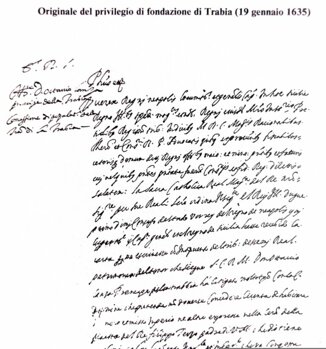
Cesare Lanza has sadly gone down in history and legend for the dramatic murder of his daughter Laura, the celebrated "Baroness of Carini." His successor, his son Ottavio, succeeded in obtaining the title of Prince of Trabia, granted to him by privilege dated July 22, 1601, and his grandson, Ottavio II, finally obtained the "licentia popolandi con mero e misto imperio," thus ending the centuries-old dispute with the city of Termini. January 19, 1635, is the official date of Trabia's foundation.
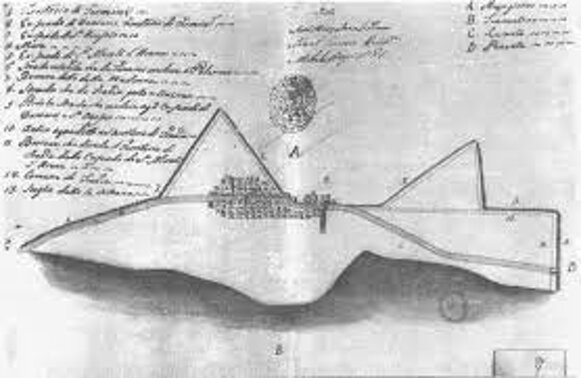
After this necessary historical summary of the events that led to the urbanization of Trabia, let's return to our main topic: pasta production. As previously mentioned, the abundant waters that flowed from the area were duly channeled to power the various mills, even the names of which are preserved in documentary sources. As Professor Giacomo Dentici, in one of the most authoritative studies on the origins of Trabia, notes that mills in Sicily were usually classified as "Supranu," "Suttanu," and "di mezzu," based, of course, on their location.
From Luca De Berberis's "Liber de Secretis" (1506), we learn that in Trabia, in the early 1500s, there was a mill called "La Porta," which King Alfonso had granted to Leonardo Di Bartolomeo and his heirs "in perpetuity," with a deed dated September 11, 1441. Also in Trabia, another existing mill was called "della Torre," and others, perhaps the oldest, were called "Soprano" and "Sottano."
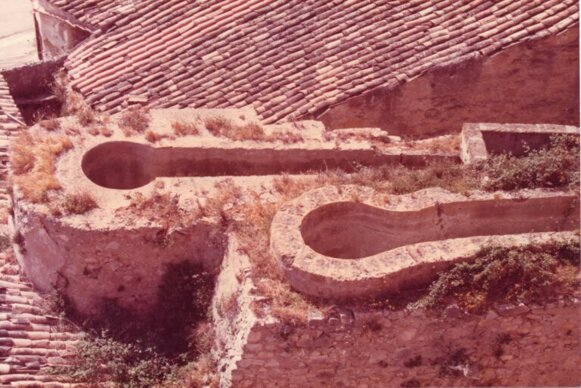
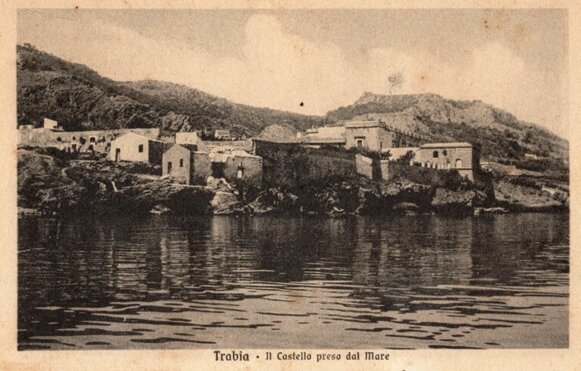
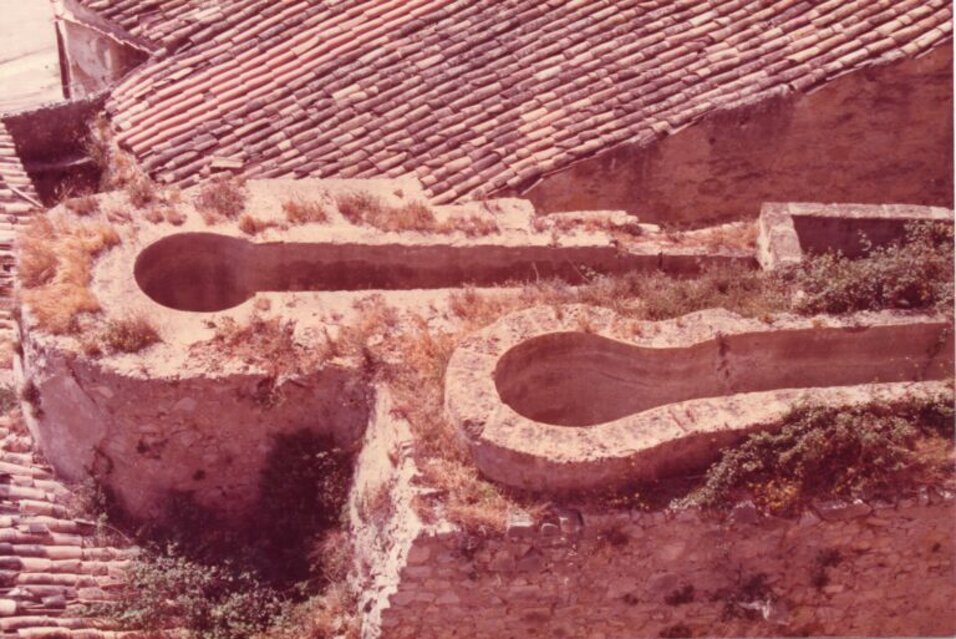
What remains of this last mill is currently located inside a building used as a car wash. The name "Piazza Mulini" (Mulini Square) provides precise evidence of the location where these ancient mills once stood. Other mills had once been built on the cliff, east of the castle, and their ruins are still visible on an old postcard from 1942.
From information gleaned from a report written in 1881 by engineer M. Capitò, we learn that four grain mills were still active and functioning at that time. Unfortunately, our documentation on the continuity of production and the history of our pasta factories is very limited. In the early decades of the twentieth century, the then mayor of Trabia, Achille Bova, author of a short essay on the town's history, stated that
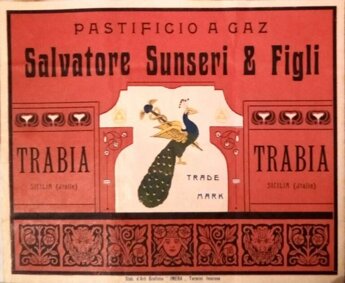
"There are several pasta and food processing machines, but the most highly acclaimed belong to the living Salvatore Sunseri, who built factories that must be visited to understand the importance of the trade he conducts with his sons, who are in the distant Americas."
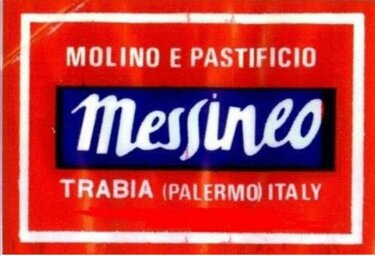
Equally important, in more recent times, was the pasta production of the Messineo family, which had its factories along what is now Via Mons. Di Matteo, where the new town hall stands. Its activity ceased towards the end of the 1960s. Meanwhile, from the personal memories of some Trabia residents, it seems that another small pasta factory, belonging to the Arrigo family, was located on Via Roma, in the current Gattuccio houses.
From a booklet published by the Trabia and the Lanza Ways association...
Research by Roberto Incardona with the collaboration of Diego Gattuccio.